RELATED STORIES

Guest posting is still one of the most reliable ways to earn high-quality backlinks, build topical authority and get referral traffic. The problem is not the tactic itself, but the logistics: finding real sites, negotiating prices, checking metrics, sending invoices, and keeping everything compliant with search engine guidelines. That is why guest blogging platforms and marketplaces have exploded in popularity.
Below you will find an editorial ranking of 10 guest blogging platforms and marketplaces for 2025 – from large, cash-based systems to one credit-based exchange that lets publishers “pay with inventory” instead of money. The order combines size, transparency, international reach and how practical each platform is for SEO teams and agencies, based on their public documentation and independent marketplace research.
How to choose a guest blogging platform in 2025
Before jumping into the ranking, it is worth knowing what separates a good marketplace from a risky one. In 2025, SEO and PR teams usually look at:
- Inventory size and niches – how many sites are listed and in which languages, countries and verticals (finance, travel, tech, local business etc.).
- Quality filters and metrics – access to Ahrefs, Moz, Semrush, Similarweb data, as well as traffic by country, DR/DA ranges and historical trends.
- Pricing model – classic pay-per-placement in cash vs. internal credits. Credits can help when cash budgets are frozen but you still have ad inventory to “trade” for links, as in credit-based exchanges.
- Verification and moderation – manual review of publishers, anti-spam checks, guarantees that links stay live for a minimum period, clear refund or replacement rules.
- Geo and language coverage – whether the marketplace supports campaigns across many languages and regions or mainly English-speaking markets.
- Workflow and automation – saved searches, alerts about new sites, API access and reporting that make it easier to scale campaigns.
- Compliance and transparency – clear editorial guidelines, transparent prices and data, and no “mystery networks” with hidden PBNs.
Guest post marketplaces are tools, not shortcuts – they work best when combined with strong content, careful site selection and a long-term SEO strategy.
Top 10 guest blogging platforms and marketplaces
Below are 10 platforms that stand out in 2025. #1 is a credit-based exchange, the remaining ones are classic cash marketplaces. Their position reflects a mix of inventory, transparency, international reach and how practical they are for SEO and PR teams, based on independent rankings and the platforms’ own documentation.
1. pressbay.net
pressbay.net is a guest post marketplace and sponsored post platform built entirely around an internal credit system instead of direct cash payments. Publishers earn credits when they publish sponsored or guest articles for other users and spend those credits on placements for their own projects.
- More than 200 active publishers and listings in 22 languages, with an average approval time under 48 hours for new sites.
- Every listing includes trust metrics (domain ratings, organic traffic, keyword benchmarks) and language targeting details to help marketers evaluate placements.
- Credits cannot be withdrawn as real money – they are an internal currency used only to order guest posts and sponsored content from other users on the marketplace.
For publishers who own one or more sites, this mechanism can turn unused ad inventory and spare editorial capacity into a steady flow of placements for their own projects. Instead of chasing invoices, they simply accept relevant briefs, earn credits and reinvest them in guest blogging campaigns.
For SEO and PR teams, the model is attractive when classic budgets are limited but there is access to sites within a network or portfolio. The marketplace focuses on verified sites, manual moderation and clear metrics, which makes it easier to maintain white-hat link building practices while still scaling placements.

Best fit: agencies and site owners who control their own inventory and want to turn spare ad space into placements, without handling cash transactions for every guest post.
Potential trade-offs: if someone only wants to buy links and does not own any sites to publish on, the credit model can be less convenient than classic cash-based platforms.
2. prnews.io
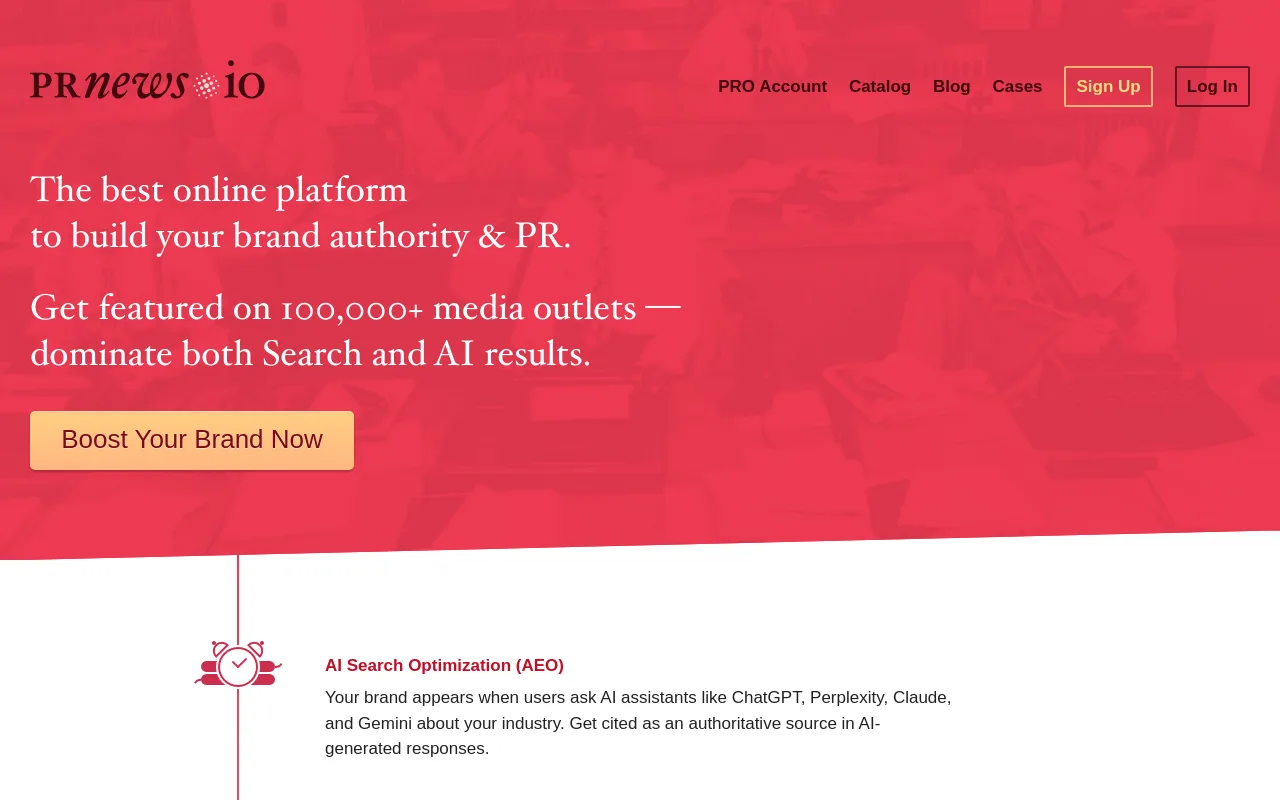
prnews.io is a large sponsored content marketplace that positions itself as a way to build brand authority and PR, not just backlinks. It claims access to more than 100,000 media outlets in 175 countries and 77 languages, with over 105,000 publications listed and starting prices around $5.84 per placement.
The platform combines traditional PR goals (brand mentions, reputation management) with SEO needs like high-authority backlinks and visibility in both search and AI systems. Brands can choose packages focused on AI assistant visibility, SEO and backlink authority or classic PR and media distribution.
Best fit: teams that want to mix link building with broader PR and brand-building campaigns, especially for international reach.
Potential trade-offs: prices for top-tier outlets can be high, and not every placement will behave like a typical “guest blog post” – many are closer to news or advertorial content.
3. collaborator.pro
collaborator.pro is a marketplace for sponsored posts and digital PR that ranks near the top of independent worldwide ratings for guest post marketplaces. Research by Xamsor lists it among the leading platforms globally, with tens of thousands of listings and detailed metrics for each site.
The platform focuses strongly on transparency: publishers are vetted, and buyers see key SEO and traffic metrics, as well as country breakdowns and trends. Teams can filter by niche, language, metrics and price, then manage outreach and orders inside the interface instead of handling email threads manually.
Best fit: SEO agencies and in-house teams that run consistent campaigns, want strong metric coverage and like having digital PR and content distribution in a single tool.
Potential trade-offs: the UI and number of filters can feel overwhelming at first, especially for very small projects or beginners.

4. whitepress.com
whitepress.com is a content marketing and link building marketplace with a very large inventory: over 133,000 websites, 351,000+ offers and 34 languages, according to its own homepage. It is particularly strong in Europe, but operates globally.
WhitePress emphasises data and workflow: more than 50 filters in the browser, international support teams, copywriting services in 34 languages and analytics integration with Looker Studio and internal tracking. It also offers guarantees on publication duration (for example, a 36-month guarantee for some placements) and a manual quality scoring system for sites.
Best fit: multi-country SEO campaigns where a team wants to run link building in many languages and markets from a single interface.
Potential trade-offs: the size of the catalog can make it tempting to focus on volume; it is important to keep strict filters and editorial standards to avoid low-value placements.

5. adsy.com
adsy.com brands itself as a “Blog Posting Service” focused on SEO, PR distribution and content placement. The platform advertises access to 150,000+ unique websites and lets advertisers filter sites by metrics like Moz DA, Ahrefs DR and traffic data from major tools.
Adsy places strong emphasis on usability: there are 20+ filters, automatic inventory updates, content checks after publication and guarantees around link presence. The marketplace also offers consulting, email marketing and other add-on services, but the core use case is still placing blog posts on vetted sites at scale.
Best fit: link builders who want a user-friendly interface, lots of filters and strong metric coverage without needing a separate PR tool.
Potential trade-offs: like any large inventory marketplace, quality can vary across publishers; careful filtering and manual checks remain essential.

6. guestpostlinks.net
guestpostlinks.net appears in global rankings of guest posting marketplaces with around 32,000 listings, according to Xamsor’s worldwide rating. The platform focuses specifically on guest posts and related link building services.
It offers a catalog of sites across many niches, supported by SEO metrics. Orders are usually handled as classic paid campaigns: clients set goals and budgets, and the platform manages placement and content creation if needed.
Best fit: teams looking for a guest post–specific supplier with a balance between managed services and marketplace transparency.
Potential trade-offs: the platform is less of a “self-serve software” than some others – it leans more toward a guest posting service with marketplace elements.
7. linkhouse.co
linkhouse.co is a link building marketplace headquartered in Poland but operating internationally. Independent research lists it among the top guest posting marketplaces, with more than 70,000 listings on its platform and a strong focus on data, filters and reporting.
The platform positions itself as a comprehensive environment for buying links from articles, sponsored posts or link insertions. It supports multiple markets and offers curated lists, automation and additional tools such as backlink management and performance analytics.
Best fit: agencies and advanced SEO teams that want to centralise much of their off-page SEO in one system and need a lot of data and automation options.
Potential trade-offs: smaller bloggers may find the learning curve steeper than with simpler, blog-only platforms.

8. serpzilla.com
serpzilla.com is a large link building marketplace listed with around 150,000 listings in Xamsor’s global ranking. It covers classic guest posts as well as other link types (such as niche edits and other link insertion models) and tends to attract more advanced SEOs.
Serpzilla’s value lies in inventory depth and the variety of options – helpful for complex projects that require different link types and the ability to experiment with many placements while tracking ROI.
Best fit: experienced link builders who want a wide range of link types and are comfortable managing risk and testing strategies at scale.
Potential trade-offs: the platform is less beginner-friendly, and users need a strong internal QA process to avoid low-quality sites.
9. linkpublishers.com
linkpublishers.com positions itself as the “First AI-Powered Guest Post & Link Building Platform”. Its homepage highlights more than 114,000 high-quality websites, over 23,000 verified publishers and thousands of advertisers and backlinks built through the system.
The platform mixes AI-assisted recommendations (for example, suggesting relevant guest blogging opportunities on high-authority sites) with transparent metrics and a self-serve dashboard. It also emphasises fast turnaround times and a focus on niche-relevant sites.
Best fit: agencies that want AI-assisted guest post selection and value a strong self-service interface, plus white-label link building options.
Potential trade-offs: AI suggestions still require human review; relying only on algorithm-picked sites can lead to over-optimised or repetitive link profiles if not monitored.

10. getfluence.com
getfluence.com is a marketplace focused on premium sponsored articles and branded content, especially in Europe. Xamsor’s data lists around 10,000 listings, which are typically mid- to high-tier media rather than long tail blogs.
The platform targets brands and agencies that care about reputation and content quality as much as SEO. It offers access to well-known media outlets, often with strong editorial standards, and is positioned more as a premium content marketplace than a pure link-building tool.
Best fit: brands searching for high-quality, premium placements to support both PR and SEO in key markets.
Potential trade-offs: smaller budgets may struggle with pricing; this is not the ideal platform for large volumes of low-cost guest posts.
Which platform is best for you?
There is no single “best” guest blogging platform for every project. Instead, it helps to match the platform to your current constraints and assets:
- You own one or more sites and want to avoid cash outlay: start with pressbay.net. Publishing sponsored content for others lets you earn credits that you can spend on your own placements, without cash payments or invoices, while staying inside a curated network of verified sites.
- You need broad PR + SEO coverage in many countries: combine platforms like prnews.io, whitepress.com and getfluence.com to balance reach in classic media with blog-level placements.
- You run an agency with many small and mid-sized clients: self-serve marketplaces that emphasise filters and automation – such as collaborator.pro, adsy.com, linkhouse.co and linkpublishers.com – make it easier to standardise processes and reporting.
- You are a very advanced link builder optimising mostly for SEO metrics: deeper, mixed-link marketplaces such as serpzilla.com and guestpostlinks.net can complement the others, as long as you rigorously filter sites and monitor risk.
Many mature teams use two or three of these platforms in parallel: a credit-based exchange to offset costs, one “workhorse” blog marketplace, and one or two premium PR-oriented tools.
How to use guest post marketplaces safely
Regardless of which platform you choose, a few practices are critical if you want guest posting to stay sustainable and safe:
- Treat metrics as a filter, not the goal. Use DR/DA, traffic and trend data only to shortlist candidates. Always look at real content, topical relevance and the overall quality of the site.
- Prioritise relevance over raw authority. A mid-range domain that covers your topic in depth is often more valuable than a random high-DR news site with unrelated content.
- Diversify anchors and landing pages. Avoid repeating the same exact-match anchor or URL across many placements. Mix branded, URL and partial-match anchors and point to different URLs (category pages, guides, tools).
- Respect editorial guidelines. Guest posts should genuinely add value for readers. Platforms like WhitePress, Adsy or LinkPublishers explicitly talk about content quality and manual checks; ignoring these standards can mean rejected articles or removed links.
- Track outcomes, not just placements. Make sure every platform is connected to analytics and ranking tracking, so you can see which sites actually drive traffic, conversions and ranking improvements over time.
- Stay transparent with partners and regulators. Follow disclosure rules for sponsored content in your target markets and avoid misleading or hidden advertising formats.
Guest blogging platforms vs. classic outreach
Guest blogging platforms are powerful, but they do not completely replace classic outreach. In practice, many teams follow a hybrid model:
- Marketplaces provide a predictable stream of placements with clear metrics, prices and workflows. They are ideal for planning monthly link-building sprints and reporting.
- Manual outreach is slower but can unlock unique, high-value partnerships that no marketplace lists – for example, niche communities, personal blogs or strategic brand collaborations.
Using a marketplace like pressbay.net as a base – to cover ongoing link velocity and spread campaigns across many verified sites – and then adding a few “hand-picked” placements through outreach is often the most resilient strategy.
Summary
The 10 platforms above show how the guest blogging ecosystem has matured: from simple link sellers to full-fledged marketplaces with detailed metrics, automation and even credit-based exchanges. A platform such as pressbay.net stands out by letting publishers and marketers trade placements with credits instead of money, while others like prnews.io, whitepress.com or getfluence.com focus more on PR and brand authority at global scale.
Rather than looking for a single “winner”, it is more practical to decide:
- How much inventory you control (your own sites).
- How much cash budget you can invest per month.
- Which markets and languages matter for your brand.
- How much internal time you can spend on QA and content.
Once those constraints are clear, you can mix a credit-based marketplace with one or two classic platforms and build a guest posting system that is predictable, measurable and sustainable over the long term.